Options are contracts between two parties that give the holder the right, but not the obligation, to buy or sell an underlying asset at a set price within a set amount of time. The Royal Bank of Canada has a good plain-language explainer, what are options, and I have listed other places to start at the bottom of this page.
There’s quite a bit to learn about options. I’ve been trading options for nearly 5 years and I can tell you I’ve only scratched the surface. Here, I am doing three things to help you: explain the pieces in plain language, show you a real example of how an options trade can multiply money (and why that is only half the story), and list the things to look out for before you buy your first contract.
The pieces of an option contract
Every option on a stock has the same few parts:
- Underlying: the stock or ETF the option is based on.
- Type: a call gives the holder the right to buy at the strike price; a put gives the right to sell.
- Strike price: the price at which the holder can buy (call) or sell (put).
- Expiration date: the last day the contract exists. After that it is worthless.
- Premium: the price of the option, quoted per share.
- Contract size: one contract usually covers 100 shares.
Because of that last point, always multiply the quoted price by 100. An option quoted at $3.00 costs $300 to buy one contract.
Buyers and sellers
Every option has two sides. The buyer pays the premium and gets the right; the most the buyer can lose is the premium. The seller (also called the writer) receives the premium and takes on the obligation: if the buyer exercises, the seller must deliver the shares (call) or buy them (put). That is why selling options carries very different risks from buying them. See covered calls and selling puts for the selling side.
So, what are options in practice?
Look at an option chain in your trading platform and you’ll see a price attached to every strike and expiration. Reading it:
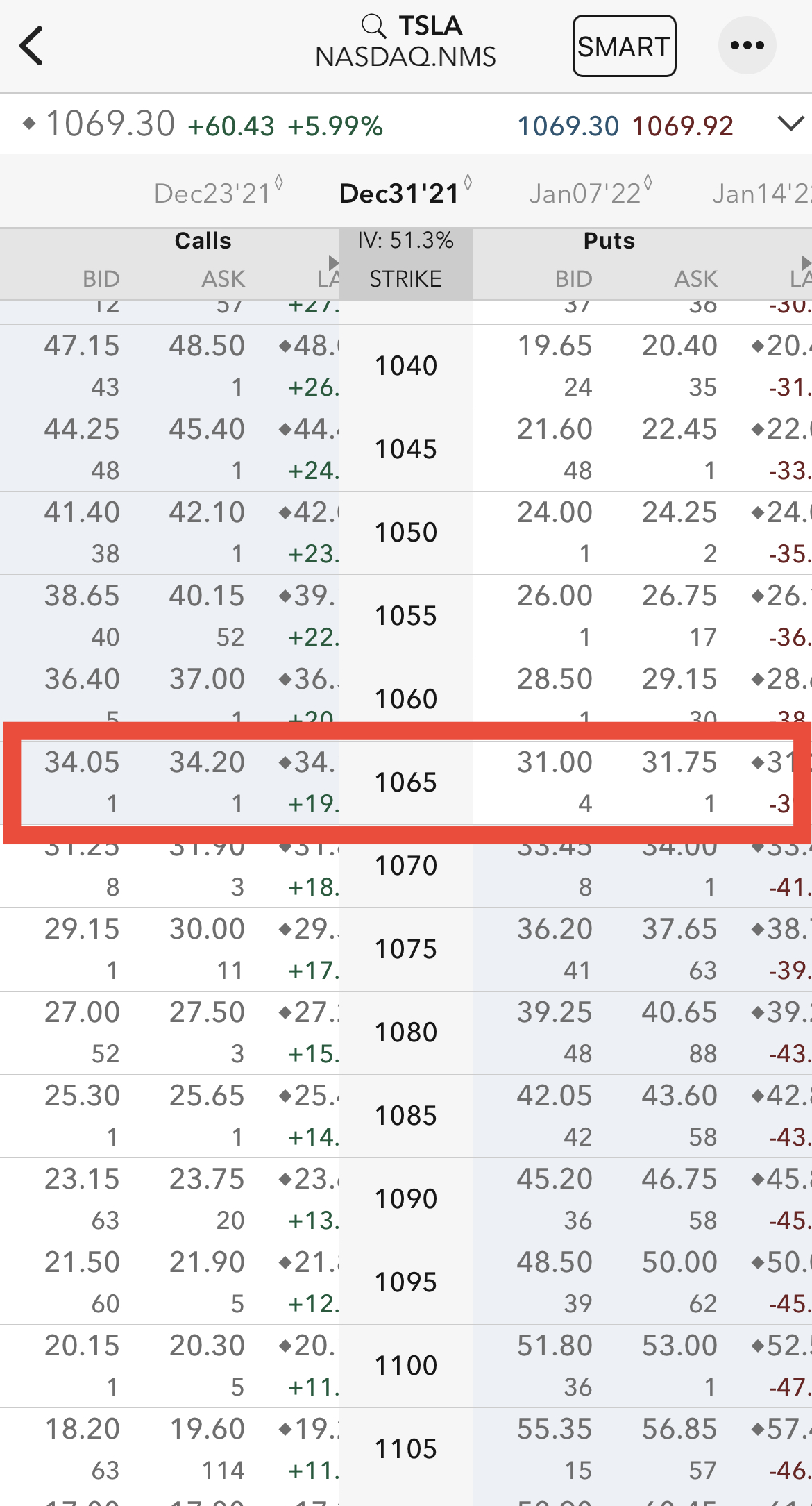
In the screenshot below, the CALL option on Tesla with the 1065 strike, expiring Dec 31, was priced at 34.20 (ask). If you think the Tesla stock price is going up and you want to buy that one option, you would pay $34.20 × 100 = $3,420.
Similarly, the PUT option at the same 1065 strike and expiration was 31.75 (ask). You would buy a PUT if you think the price is going down.
(This screenshot is from December 2021. Tesla later did a 3-for-1 stock split in August 2022, so today’s prices are about a third of those shown.)
What’s a CALL and a PUT?
This is a good article explaining it. But I promised I’d explain this in layman’s terms. So here we go:
CALL -> you think the stock price is going up
PUT -> you think the stock price is going down
A lot of beginners ask why deal with options at all. Why not simply buy the stock? LEVERAGE! That is why experienced investors trade options.
Options can provide leverage. This means an option buyer can pay a relatively small premium for market exposure in relation to the contract value (usually 100 shares of the underlying stock). An investor can see large percentage gains from comparatively small, favorable percentage moves in the underlying product.
Take a look at the following screenshot. I actually took this from Twitter.

What happened here?
This trader bought a Dec 23, 1035 strike Tesla option for 1.84. Remember, one option is 100 shares, so he paid $184 to enter the trade.
The option rose to $35.47, a gain of $3,363.17 on a $184 investment, a whopping 1824.64%.
How long would you have to wait to make 1824.64% if you simply bought the stock?
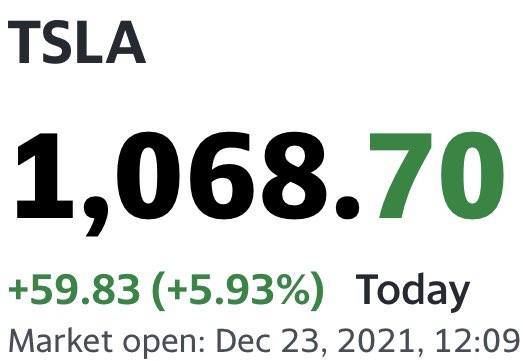
Take a look at the following. Remember, option = leverage. Tesla went up by 5.93% to a price of $1068.70. But the option price went up 1824.64%.
Now read this twice:
Not all options will end like that. This trade is essentially a gamble. The option was expiring that same day, Dec 23. If Tesla had finished under $1035, this trader would have lost the entire $184. But think about it: he risked $184 to make $3,363.17. That is a great trade when it works. As the old saying goes, gotta be good to be lucky, and gotta be lucky to be good.
It is also a screenshot someone chose to post because it worked. You rarely see the screenshots of the options that expired worthless, and an option that is a long shot to finish in the money does expire worthless most of the time.
What gives an option its price
An option’s premium has two parts:
- Intrinsic value: what it would be worth if exercised right now. A $100-strike call on a $105 stock has $5 of intrinsic value. If the stock were at $95, it would have none.
- Time value (extrinsic value): what buyers pay for the chance the option gets more valuable before it expires. It shrinks as expiration approaches and is larger when the stock is volatile.
Where the strike sits relative to the stock price gives the option a name:
| Term | Call | Put |
|---|---|---|
| In the money (ITM) | Strike below the stock price | Strike above the stock price |
| At the money (ATM) | Strike near the stock price | Strike near the stock price |
| Out of the money (OTM) | Strike above the stock price | Strike below the stock price |
Out-of-the-money options have no intrinsic value, which is why they are cheaper, and why most of them expire worthless.
What to look out for when buying options
This is the part the screenshot above does not show.
- Time decay. Every day that passes removes some time value, and the loss speeds up near expiration. Buying an option means you need the stock to move enough, soon enough. Being right about direction but late can still lose money.
- Implied volatility. Options get more expensive when the market expects big moves, such as before earnings. After the news, implied volatility often falls sharply, and the option can lose value even if the stock moved in your favor. People call this a volatility crush.
- You must be right on three things: direction, size of the move, and timing. A stock ending above your strike by expiration is not enough if it did not exceed your breakeven: strike + premium for a call, strike − premium for a put.
- Liquidity. Check the bid-ask spread and the volume and open interest at your strike. A wide spread is a hidden cost. See options volume vs open interest.
- Position size. Because options can go to zero, size them as if they will. A common starting point is to risk a small, fixed percentage of the account on any one trade. The position size calculator and the guide to options position sizing walk through it.
- Have an exit plan. Decide beforehand when you will take a profit and when you will accept the loss.
The Greeks, in one line each
The Greeks measure how an option’s price responds to different forces. You do not need to master them on day one, but you will see them on every platform.
- Delta: how much the option price moves for a $1 move in the stock. Also loosely used as a rough chance of finishing in the money.
- Gamma: how fast delta itself changes.
- Theta: how much value the option loses each day to time decay.
- Vega: how much the option price changes for a one-point change in implied volatility.
Exercise, assignment and expiration
An option ends in one of three ways: the holder exercises it, the holder sells it before expiration, or it expires. Most traders sell before expiration rather than exercising. If an option you sold is exercised, you are assigned, which is covered in options assignment risk. Most stock options in the US can be exercised at any time before expiration; some index options can only be exercised at expiration.
Where to go from here
- Practice the math with the options profit calculator, which shows max profit, max loss and breakeven for seven strategies.
- Pick a strategy by market outlook in the options strategies guide.
- Learn the vocabulary in the options glossary.
- For income-oriented strategies that use shares you own, start with covered calls.
websites to get you started with option trading
- https://www6.royalbank.com/en/di/hubs/investing-academy/chapter/what-are-options/jv7atfyu/jv7atg0t
- https://www.ally.com/do-it-right/investing/trading-options-for-beginners/
- https://www.investopedia.com/options-basics-tutorial-4583012
Educational use only. Options involve risk and are not suitable for every investor. This is not advice to buy or sell any security.